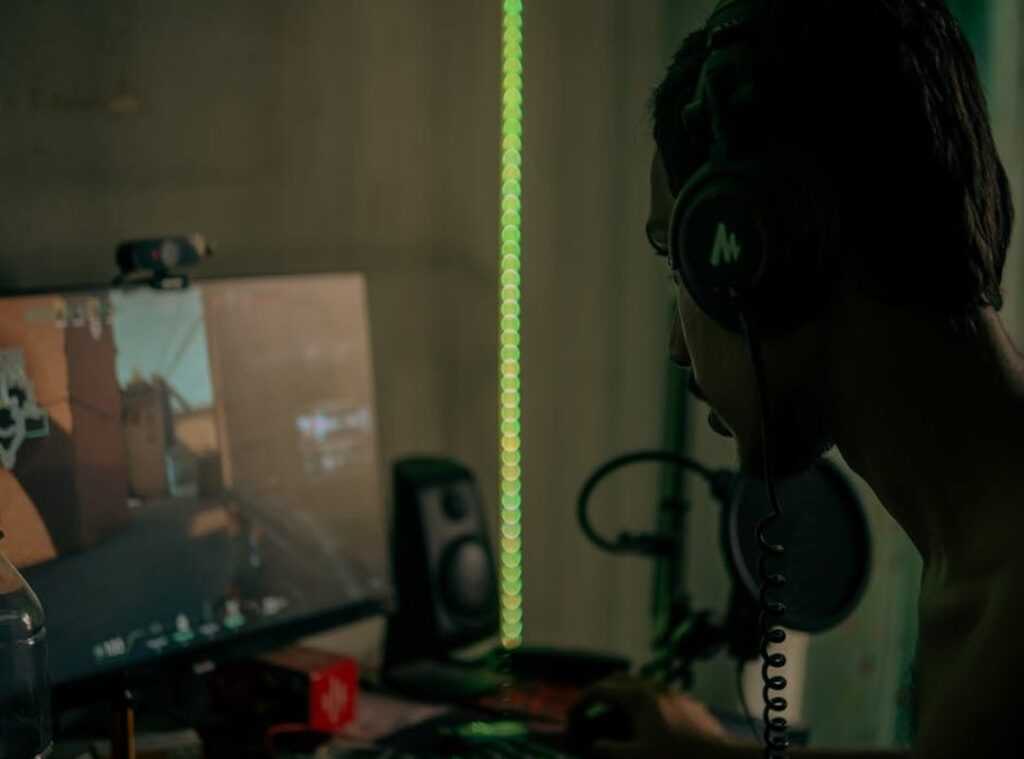

A goal goes in. Your phone buzzes.
Three seconds later, you actually see the ball hit the net on the stream.
That gap is latency. A few seconds sounds trivial until you’re watching live sport, an esports final, or playing through a cloud gaming service. Then it suddenly matters quite a lot.
A live stream takes the long route
The picture on your screen doesn’t travel straight from the camera to you.
It has to be captured, encoded, sent through servers, distributed across networks, then decoded again by your device. Every step adds a little time. Distance matters too – if the server is far away, the data has to travel farther.
CDNs (content delivery networks) help: they send content from a faster server that’s closer to the user to speed things up.
Even then, two people watching the same match can be several seconds apart.
Different provider. Different device. Different route through the internet. Maybe different stream settings as well.
Buffering is annoying, but it has a job
Buffering gets blamed whenever a stream feels slow, but the buffer is there for a reason.
The player keeps a small amount of video ready in advance. If your connection stumbles for a moment, playback can continue instead of freezing immediately.
The downside is obvious: more video stored ahead usually means more delay.
Live platforms often offer lower-latency modes, but reducing that safety margin can make the stream more vulnerable to network problems. You get closer to real time, but there is less room for the connection to misbehave.
No setting gives everyone zero delay and flawless playback.
Sometimes the score arrives before the goal
Video isn’t the only live information moving around during a match.
You might have a stream open next to a live-score app, fantasy platform, stats page, or a service offering live sports betting in UAE. All of them depend on fresh data, but they are not sending the same kind of data.
A score update might be a tiny message saying a goal happened.
The video stream has to deliver moving high-resolution images and audio continuously.
So the smaller message often gets there first. Your phone tells you the score, then the television catches up a few seconds later.
Anyone who has watched football with notifications turned on has probably met this problem already.
Cloud gaming is less forgiving
Cloud gaming is different. The game reacts to your actions, renders the content, and sends the data to your screen. This means a constant back-and-forth between the server and your computer. Connection quality isn’t just about download speed – it’s about data flowing both ways. A connection can look fast on paper and still feel slightly wrong in your hands.
Some of the delay is sitting on your desk
The network doesn’t cause every millisecond.
Your controller or mouse has to register what you did. The computer has to process it. A frame has to be rendered. Then the display has to show it.
The screen adds its own timing. A 60 Hz display redraws the screen’s content around 60 times a second. Higher-refresh displays update more often. But that won’t fix a slow route to a distant server – It just removes another source of delay closer to you.
It’s easy to blame the Wi-Fi for everything.
Sometimes the network is only part of it.
Fast internet and low latency aren’t the same thing
A speed test can show a strong connection while a live service still feels delayed.
“Bandwidth” only tells you how much data the connection can carry – or how wide the pipe is. It’s the latency that shows you how long that data takes to reach you. And there are many things that can influence it, from Wi-Fi interference to stream configuration. These all add up.
Video providers also make technical trade-offs during encoding. Settings that reduce latency may come with costs elsewhere, such as lower tolerance for network instability or less efficient delivery.
There usually isn’t one switch marked “make it live.”
Why two screens rarely agree
Most of this stays invisible until something gives it away.
A stream freezes. A cloud game feels sluggish. Someone in the next apartment cheers before you’ve even seen the shot.
By the time that goal reaches your screen, it may already have passed through an encoder, several network links, a CDN, your router, the player buffer and finally the display.
Then the neighbour upstairs starts shouting.
 David Wellstazion writes the kind of multiplayer strategy insights content that people actually send to each other. Not because it's flashy or controversial, but because it's the sort of thing where you read it and immediately think of three people who need to see it. David has a talent for identifying the questions that a lot of people have but haven't quite figured out how to articulate yet — and then answering them properly.
They covers a lot of ground: Multiplayer Strategy Insights, Industry Buzz, Controller Setup and Input Hacks, and plenty of adjacent territory that doesn't always get treated with the same seriousness. The consistency across all of it is a certain kind of respect for the reader. David doesn't assume people are stupid, and they doesn't assume they know everything either. They writes for someone who is genuinely trying to figure something out — because that's usually who's actually reading. That assumption shapes everything from how they structures an explanation to how much background they includes before getting to the point.
Beyond the practical stuff, there's something in David's writing that reflects a real investment in the subject — not performed enthusiasm, but the kind of sustained interest that produces insight over time. They has been paying attention to multiplayer strategy insights long enough that they notices things a more casual observer would miss. That depth shows up in the work in ways that are hard to fake.
David Wellstazion writes the kind of multiplayer strategy insights content that people actually send to each other. Not because it's flashy or controversial, but because it's the sort of thing where you read it and immediately think of three people who need to see it. David has a talent for identifying the questions that a lot of people have but haven't quite figured out how to articulate yet — and then answering them properly.
They covers a lot of ground: Multiplayer Strategy Insights, Industry Buzz, Controller Setup and Input Hacks, and plenty of adjacent territory that doesn't always get treated with the same seriousness. The consistency across all of it is a certain kind of respect for the reader. David doesn't assume people are stupid, and they doesn't assume they know everything either. They writes for someone who is genuinely trying to figure something out — because that's usually who's actually reading. That assumption shapes everything from how they structures an explanation to how much background they includes before getting to the point.
Beyond the practical stuff, there's something in David's writing that reflects a real investment in the subject — not performed enthusiasm, but the kind of sustained interest that produces insight over time. They has been paying attention to multiplayer strategy insights long enough that they notices things a more casual observer would miss. That depth shows up in the work in ways that are hard to fake.